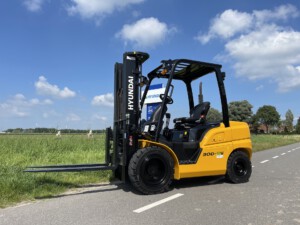
How high may you stacking with a forklift?
There is no fixed stacking height that is safe in every situation. How high you can stack with a forklift depends on the combination of machine, load, pallet, floor, work environment, and visibility. Not only the maximum lifting height of the mast is important, but especially whether the load can still be placed stably, controllably, and safely at that height.
In practice, things often go wrong when companies only look at “how high the forklift can reach,” while factors such as the load center of gravity, pallet quality, clearance in the warehouse, and remaining capacity at height are just as decisive.

Why there is no universal maximum stacking height
Two forklifts with the same mast height can perform very differently at greater heights in practice. This is because safe stacking height depends not only on the machine but also on the specific load you want to place. A compact, stable pallet with a favorable center of gravity is very different from a tall, irregular, or poorly wrapped load.
The work environment also matters. A forklift operates differently on a flat warehouse floor with enough space than on a busy shipping floor, an outdoor area, or a location with narrow aisles and limited visibility.
What factors determine if stacking to height is safe?
The load itself
- the total weight of the load;
- the distribution of weight over the pallet;
- the height and shape of the load;
- the quality of packaging and wrapping;
- the position of the center of gravity.
The situation surrounding it
- floor condition and flatness;
- Channel width and overhead clearance;
- view of the theorem or stack position;
- Driver experience and instruction;
- the type of forklift, mast, and any attachments.
Anyone who wants to stack safely must therefore always consider the complete combination of machine, load, and environment.
The center of gravity is more important than many people think
A common mistake is to only look at the lifting capacity on paper. In reality, the load on the forklift changes as soon as the center of gravity of the load is further forward, for example with long goods, deeper pallets, or uneven loading. This can reduce the safe capacity.
This is precisely why a pallet that feels stable at a low height can become shaky or unsafe at a greater height. A load that isn't compact and stable on the forks requires more attention than a standard pallet with evenly distributed goods.
Floor, space, and visibility are also decisive.
High stacking requires not only a suitable machine, but also a suitable workspace. When the floor is uneven, the aisles are narrow, or there is little visibility of the final placement, the risk of incorrect positioning, rack contact, or an unstable movement increases.
This is especially important in busy warehouses. Here, not only height and weight are factors, but also the presence of other vehicles, pedestrians, racks, and tight maneuvers.


Which forklift is best suited for stacking work?
For warehouse work and internal transport, a electric forklift often a logical choice. At HeftruckHuren.com, that category ranges from 1.5 to 16 tons. For mixed indoor and outdoor use, a LPG forklift interesting, while a Diesel forklift often fits better with heavier outdoor terrain or robust industrial use.
Practical checklist before stacking high
- Check if the pallet and packaging are undamaged.
- Ensure the load is stable and centered on the forks.
- Check if the forks provide enough support.
- Work calmly and without sudden steering or braking.
- Check clearance, headroom, and sightlines.
- Use a forklift whose capacity and mast truly match the task.
- Ensure the driver is well-instructed for the work situation.
The right question is not: how high does the mast go?
The better question is: how high can this specific load be safely placed in this specific environment? Once you look at it that way, it becomes clear why safe stacking height is always custom-made.
This is precisely why good advice is important for temporary deployment, peak loads, or project work. With the right machine, you prevent damage to goods, racks, floors, and your logistics planning.
Want to know more or need a suitable forklift?
Op ForkliftRental.com do you have the current rental overview of Hyundai forklifts from 1.5 to 30 tons. If you need a machine structurally, you can also look at newforkliftpurchase.nl for new Hyundai forklifts through the official importer.
Are you unsure which forklift is right for your stacking needs?
Provide your load weight, desired lifting height, work environment, and operating duration. Then we will recommend which Hyundai forklift is best suited for safe and efficient work at your location.
Frequently Asked Questions
How high can you stack with a forklift?
That depends on the machine, the load, the load's center of gravity, the pallet quality, and the work environment. Therefore, there is no fixed safe height that applies to every situation.
Why is the center of gravity so important?
Because an unfavorable center of gravity affects the stability of the forklift. The further the weight is forward, the more it affects the safe capacity.
Is an electric forklift suitable for high stacking?
That is certainly possible, especially in warehouses and on flat floors. However, lifting height, capacity, and application must be well-matched.
When is advance advice smart?
Especially for higher storage, heavier loads, narrow aisles, irregular pallets, or temporary deployment, advice beforehand is wise to prevent damage and downtime.