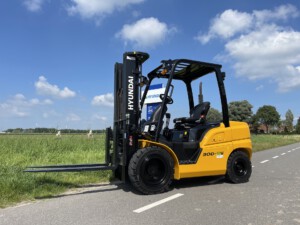
How do you prevent damage to floor, shelving, and goods with a forklift?
Damage caused by forklifts doesn't always result from major mistakes. In practice, it's often caused by small, repeated issues: turning too sharply, not picking up a load quite right, insufficient visibility in an aisle, the wrong tires for the floor surface, or a machine that isn't actually suitable for the environment.
This is precisely why damage prevention is not a standalone action, but a combination of correct machine selection, calm driving behavior, good workplace design, and load control. Those who manage this foundation well will prevent damage to goods, racking, doors, dock edges, and floors.

Damage often begins before the first ride.
A lot of damage doesn't occur during operation, but already during the selection of the machine. A forklift that is too large in narrow aisles, an unsuitable tire on a sensitive floor, the wrong mast for the available space, or a machine that is too heavy for the logistics route almost inevitably leads to unnecessary risks.
That's why it's smart to look not only at lifting capacity beforehand, but also at the ground, aisle width, pivot points, thresholds, loading docks, doors, racking, and the nature of the load.
Picking up the load properly prevents a lot of damage.
Pay attention here to pallets and loads
- Set the forks at the correct width;
- place the forks far enough under the load;
- Check if the pallet is straight and undamaged.;
- Check if the load is stable and evenly distributed;
- calmly and without abrupt movements.
Why this is important
A pallet that is picked up crookedly or rests only partially on the forks becomes unstable more quickly. This increases the risk of product damage, rack contact, or damage to the floor and packaging during transport or placement of the load.
Driving too fast is one of the biggest causes of damage.
In warehouses and logistics environments, damage often occurs because drivers steer, brake, or turn just a bit too fast. Especially with a load on the forks, this causes the machine to become unstable and less controllable on turns, intersections, racking, and docks.
Starting smoothly, braking fluidly, and steering precisely may sound simple, but it makes a big difference in practice. It not only reduces the chance of collisions but also limits floor wear, shocks to the load, and damage to racks or doors.
Sightlines and blind spots deserve extra attention
A lot of damage occurs in places where the driver has just not had good visibility: at rack ends, aisle intersections, trailer openings, docks, and when turning around pallets or storage locations. Especially when the load partially blocks visibility, the chance of contact with goods, racks, or people is greater.
Good routing, clear walkways, sufficient space, and a spotter where needed help prevent damage and unsafe situations. It also helps to establish fixed driving directions and clear stopping or viewing points.


The floor also plays a big role
Not every floor reacts the same way to internal transport. A smooth warehouse floor requires different grip and driving behavior than an outdoor area with pavers, a loading bay, or a route with thresholds and inclines. On sensitive floors, it also matters whether tires leave streaks or exert extra pressure on the surface.
This is precisely why the right choice of tires and machinery is important. An electric forklift with appropriate tires can be ideal for indoor work, while on rougher terrain or mixed use, a different configuration is better suited.
The work environment must help prevent damage.
Damage prevention is not solely the driver's responsibility. The workplace layout also plays a role. Consider sufficient turning radius, clear markings, unobstructed passageways, well-placed racks, sturdy pallets, and a safe loading and unloading zone.
Where pedestrians and forklifts work in close proximity, walkways, barriers, and clear visual arrangements are extra important. This not only contributes to safety but also helps prevent damage from evasive maneuvers and last-minute corrections.
Which forklift helps actually limit damage?
The best machine is usually the forklift that best matches the work environment. The following internal links will help visitors find the right direction:
Internal links that make this blog extra strong
A short checklist to mitigate damage
- Choose a forklift that fits the space, floor, and load.;
- Check pallets and packaging before every trip;
- drive slowly, especially on turns, intersections, and docks;
- Keep sightlines clear and use a spotter where necessary.;
- Ensure clear walkways and traffic arrangements.;
- Adjust the belts and machine to the surface;
- Keep good track of maintenance and inspections.
For temporary deployment, good advice is often cheaper than damage.
Companies often look at availability and price first when renting, but in practice, the right configuration often yields the most. A suitable machine, good tires, the correct mast, and clear deployment agreements help to pick up the pace without unnecessary damage to your logistics environment.
External sources
Preventing damage starts with the right forklift
Provide your ground surface, route, load type, lifting height, and application. Then we will advise which Hyundai forklift, tires, and configuration best suit safe and efficient work at your location.
Frequently Asked Questions
How do you prevent damage to racking with a forklift?
By driving slowly, picking up the load stably, maintaining sufficient visibility, and choosing a machine that fits the working width and lifting height of the location.
How do you prevent damage to floors?
Through the right tire and machine selection, adapted driving behavior, and good adjustment to the surface and route.
What often causes product damage during forklift operations?
Uneven pallet handling, insufficient fork support, erratic driving, and limited visibility are common causes of damage to goods and packaging.
Is good maintenance also important to limit damage?
Yes. Regular maintenance, inspection, and daily checks help prevent unsafe or unpredictable machine behavior.