What do you need to check before you start a forklift?
A pre-use forklift check takes only a few minutes but prevents many problems. Not only breakdowns and downtime, but also damage to goods, floors, racks, and unsafe situations on the work floor. For precisely this reason, official guidelines assume a daily or pre-shift inspection.
The best approach is to first inspect the work environment, then visually check the forklift, and finally briefly test its main functions. This way, you can more quickly determine if the machine is safe and suitable for the task at hand.

Always start with the environment.
Even before you look at the forklift itself, it's wise to first assess the route and the work area. Is the floor clear? Are there any obstacles on the ground or above the driving route? Is the work area dry and easy to navigate? And is this the right type of forklift for the current environment?
Especially when deployment varies, with project work, or during peak times, that initial check is important. A machine that works perfectly in one location may be less suitable in another due to different ground conditions, less space, or a different logistical flow.
Then visually inspect the forklift.
Key visual points
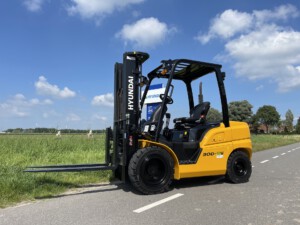
- General condition and cleanliness of the machine;
- base and support structure;
- Mast and hoist chains;
- Tires and wheels;
- Hydraulics and visible leaks;
- overhead guard and cabin parts;
- mirrors, lighting, and any windows;
- identification or capacity plate.
Why this step is important
Many problems are already visible without the forklift running. Consider wear on the forks, damage to tires, oil leaks, a defective lamp, or a loose part. By spotting these issues beforehand, you prevent a minor deviation from becoming a larger problem during operation.
Check the power source or fuel system as well
The inspection point differs depending on the type of machine. For electric forklifts, you'll focus more on the battery, cables, connectors, and charge status. For LPG, gas, or diesel machines, it's more about fuel level, visible leaks, and the general condition of the system.
Especially with LPG, it's wise to pay extra attention to tank mounting, hose condition, and visible anomalies. For electric trucks, a damaged plug, cable, or battery environment is precisely an important signal not to start before it's checked.
Then test the functions briefly before use
After the visual inspection, a brief operational check follows. This is to confirm that the machine behaves safely in actual use. Consider things like brakes, steering, horn, warning signals, hydraulic functions, and any lighting or gauges.


When are you not allowed to start?
If you see anything that could compromise safe use, the forklift should not be immediately put into operation. Consider leaks, defective brakes, visible damage to tires or forks, poor lighting, an illegible capacity plate, or a malfunction in the steering or hydraulics.
The practical rule is simple: if you're unsure whether the machine is safe, have it inspected first and then use it. This prevents risks for the driver, the environment, and the cargo.
The right forklift also makes the daily check easier
A machine that fits well with the environment often works more predictably and causes less stress in daily use. Therefore, choosing the right type of forklift is also part of a safe start. On HeftruckHuren.com, these internal links help visitors directly:
Internal links that make this blog extra strong
A short daily checklist for the practice
- check floor, route, and surroundings for obstacles;
- look at forks, mast, chains, tires, and wheels;
- check for leaks or visible damage;
- Watch out for mirrors, lights, windows, and general cleanliness;
- Check power source, fuel, or battery environment;
- Test brakes, steering, horn, and hydraulic functions.;
- Do not use the machine if you are unsure about safety.
For temporary deployment, good control is extra important
Especially with rentals, peak deployments, project work, or changing drivers, a fixed pre-use routine is smart. This reduces the chance of surprises during work and keeps the logistical flow more reliable.
External sources
Are you unsure which forklift best fits your application?
Provide your work environment, ground surface, lifting height, and usage. Then we will advise which Hyundai forklift best suits safe, efficient, and reliable work at your location.
Frequently Asked Questions
Do you have to check a forklift every day?
Yes, official guidelines assume a daily or pre-shift inspection so that visible and functional problems are discovered before use.
What parts do you check before use?
Think about forks, mast, chains, tires, wheels, hydraulics, power source or fuel system, mirrors, lights, and the general condition of the machine.
Do you also have to check the surroundings?
Yes. Obstacles on the floor, limited space, slippery patches, or confusing situations are just as important as the machine itself.
What do you do when you see a deviation?
Do not use the forklift directly, but have the deviation assessed or rectified before the machine is put into operation.