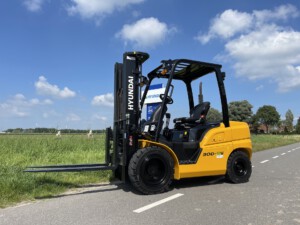
1.5 ton (compact)
For narrow spaces & light internal transport
3-wheel, maneuverable and quiet. Popular in retail, e-commerce and smaller warehouses.
This article explains what an electric forklift is and how to choose the right type. Would you like to rent one? You can do so on the page electric forklift rental: from 1.5 to 18 tonnes, from €75 per day (1.5 tonnes, excl. VAT).
Updated on 13 October 2026.
Looking for the best electric forklift for your warehouse, production environment or zero-emission use? Below you will find a practical selection guide (3-wheel vs 4-wheel, Li-ion vs lead, lift height, tyres and options).
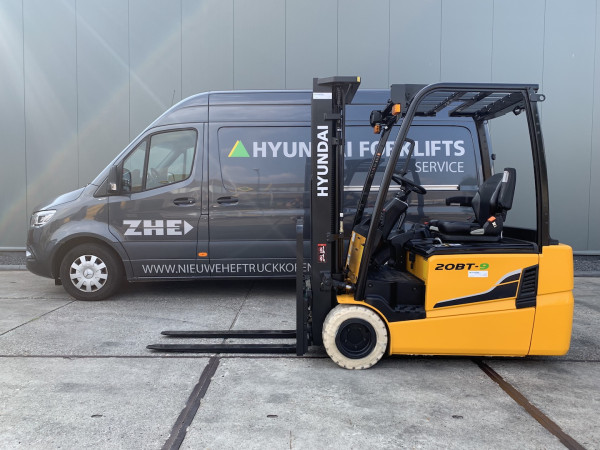

A electric forklift is an electric forklift (battery-powered) instead of diesel or LPG. This allows you to work stil, emission-free and often with low energy consumption per operating hour. In warehouses, manufacturing, and logistics, electric power is therefore increasingly becoming the standard.
You don’t make a real difference just by going “electric”—you do it with the right combination of: lifting capacity, mast/headroom, 3-wheel or 4-wheel, Accu-type and Tires/Options.
Further elaboration Li-ion Forklift Guide • 3-wheelers vs. 4-wheelers: Choosing the right one • cooling/freezing insert
This page is a decision aid. Do you want to Availability and offersThen go to:
Indoor/outdoor mix? Also see: LPG forklift and diesel forklift.
Choose electric if you work indoors or outdoors on paved ground: the forklift is quiet and produces no exhaust fumes in the workplace. For rough terrain and the heaviest loads, diesel is a better fit; for alternating indoor and outdoor use without a charging point, LPG. You can read the comparisons in electric or diesel forklift rental? and electric or LPG forklift rental?
Use this as a quick decision rule. When in doubt, call us and we'll determine the right type and configuration in 2 minutes.
| Situation | Best choice | Why |
|---|---|---|
| Interior (warehouse/production) | Electric | Quiet, emission-free, precise maneuvering, pleasant for operators. |
| Mix of indoor/outdoor, peak load, quick turnaround | LPG (with ventilation inside) | Fast refueling, flexible for changing deployments. |
| Outdoor/rough terrain/heavy duty | Diesel of heavy-duty | Maximum traction, torque, and robustness for demanding conditions. |
The choice is usually simple: space versus stability.
Deepening compact forklift (3-wheel) • Choice aid: 3- vs 4-wheel
The battery determines your uptime. Those who work multiple shifts often benefit greatly from Li-ion batteries (opportunity charging).
Read on: Li-ion Forklift Guide
Do you want rates? Check out: prices (or request a proposal directly).
With the right options, you'll work faster and more calmly. Especially in busy warehouses and at docks.
Faster positioning without repeatedly piercing → less damage and more pace.
Useful on clean floors (retail/food) and prevents black marks.
Increased visibility at intersections and blind spots → safer internal transport.
Ideal for low doors/containers and high shelves.
Comfort and protection in colder zones or (partially) outdoor use.
Bucket/grapple, fork extensions, clamps — always bring these due to the load center of gravity.
Attachment example: forklift with bucket.
Below are a few frequently requested asset classes. Prefer everything in one overview? View the full category.
Considering a purchase? Check stock: New electric forklifts (in stock).External brand overview: Hyundai electric forklifts.
An electric forklift is a counterbalance forklift powered by a battery. The load sits on the forks in front of the front axle, and the truck’s own weight keeps it in balance. The battery powers the drive motor for travelling and the hydraulic pump motor that lifts and tilts the mast.
You can see that balance in the Hyundai datasheet: with 2,000 kg on the forks, the front axle of a 20BT-9U carries 4,956 kg and the rear axle only 586 kg. The battery is part of the counterweight: Hyundai calculates the lifting capacity of the BT-9U with a battery of at least 820 kg. The rated capacity applies at a load centre of 500 mm (600 mm on the B-X from 6 to 12 tonnes) with the standard mast. With the tallest mast, a 20BT-9U lifts 1,050 kg to 7,040 mm according to the mast table (without sideshift).
Electric forklifts differ in the number of wheels, the lifting capacity and the battery voltage. Our rental range has three groups: 3-wheelers from 1.5 to 2 tonnes, 4-wheelers from 2 to 3.5 tonnes and heavy electric forklifts from 4 to 18 tonnes.
| Type | Hyundai series | Capacity | Battery voltage | Lift height (depending on the mast) |
|---|---|---|---|---|
| 3-wheel | BT-9U | 1.5, 1.8 and 2 tonnes | 48 V | 3,030 to 7,040 mm |
| 4-wheel | BE-X and BH-9 | 2 to 3.5 tonnes | 48 V or 80 V | 2,950 to 7,005 mm |
| 4-wheel, heavy | B-9 | 4 to 5 tonnes | 80 V | 2,920 to 6,030 mm |
| 4-wheel, high-voltage | B-X | 5.5 to 9 tonnes | 309 to 348 V, lithium-ion | 2,720 to 7,650 mm |
| 4-wheel, high-voltage | B-X | 10 to 18 tonnes | 618 V, lithium-ion | 3,005 to 7,525 mm |
The working aisle width (Ast) in the table below is the aisle needed to put a 1000 × 1200 mm pallet into a rack or take it out at right angles; from 1.5 to 12 tonnes it rises, according to the datasheets, from 3,245 to 6,660 mm.
| Machine | Lifting capacity | Design | Turning radius | Working aisle width | Service weight | Daily rate from |
|---|---|---|---|---|---|---|
| Electric forklift 1.5 ton (ideal for narrow spaces) | 1,500 kg | 3-wheel | 1,540 mm | 3,245 mm | 3,118 kg | €75 |
| Electric forklift 2 ton (ideal for small spaces) | 2,000 kg | 3-wheel | 1,660 mm | 3,365 mm | 3,542 kg | €85 |
| Hyundai 20BE-X | 2,000 kg | 4-wheel | 1,910 mm | 3,525 mm | 3,677 kg | €85 |
| Electric forklift 2.5 tonnes | 2,500 kg | 4-wheel | 2,135 mm | 3,858 mm | 4,484 kg | €85 |
| Electric forklift 3.5 tonnes | 3,500 kg | 4-wheel | 2,457 mm | 4,130 mm | 5,272 kg | €105 |
| Electric forklift 6 tonnes | 6,000 kg | 4-wheel | 3,380 mm | 5,190 mm | 9,704 kg | on request |
| Electric forklift 12 tonnes | 12,000 kg | 4-wheel | 4,350 mm | 6,660 mm | 16,160 kg | on request |
Technical data: VDI 2198 data sheets from Hyundai Material Handling (standard version). Daily rate excl. VAT; the current price is shown on the machine's page.
Hyundai’s BT-9U, BE-X, BH-9 and B-9 run on 48 or 80 volts; lithium-ion is an option on the BT-9U and the BE-X. The heavy B-X uses a high-voltage lithium-ion battery of the LFP type (lithium iron phosphate), from 309 to 618 volts.
| Model | Battery per datasheet | Lithium-ion | Battery weight |
|---|---|---|---|
| 15BT-9U, 18BT-9U, 20BT-9U | 48 V / 440 Ah (15BT-9U) or 510 Ah | option: 51.5 V / 376 or 470 Ah | at least 820 or 1,000 kg |
| 20BE-X | lead-acid 48 V / 420 Ah, option 450 Ah | option: 51.2 V / 300 Ah | 707 kg |
| 25BE-X | lead-acid 48 V / 600 Ah, option 660 Ah | option: 51.2 V / 450 Ah | 950 kg |
| 35BE-X | lead-acid 80 V / 500 Ah, option 550 Ah | option: 83.2 V / 450 Ah | 1,295 kg |
| 40B-9, 45B-9, 50B-9 | 80 V / 700 Ah | not stated | 2,095 to 2,200 kg |
| 55B-X to 90B-X | lithium-ion (LFP), 309 or 348 V, 53 to 93 kWh | standard | 714 or 730 kg |
| 100B-X, 120B-X | lithium-ion (LFP), 618 V, 140 or 166 kWh | standard | 2,050 kg |
According to Hyundai’s BT-9U brochure, a lithium-ion battery needs no topping up with water, gives off no hazardous gases while charging and lasts more than 4,000 charging cycles, at least twice as long as a lead-acid battery. The battery fitted to your rental machine is set out in the quotation. The trade-offs are explained in lead-acid or lithium-ion forklift.
An electric forklift produces no exhaust fumes at the workplace; an LPG or diesel forklift has a combustion engine. We rent out electric forklifts from 1.5 to 18 tonnes, LPG from 1.5 to 5 tonnes and diesel from 2.5 to 30 tonnes.
| Feature | Electric | LPG | Diesel |
|---|---|---|---|
| Capacity in our rental range | 1.5 to 18 tonnes | 1.5 to 5 tonnes | 2.5 to 30 tonnes |
| Daily rental from, excl. VAT | €75 | €70 | €75 |
| Energy | battery, charged from the mains | gas bottle, swapped when empty | diesel tank, refuelled |
| Exhaust fumes at the workplace | none | yes; Hyundai L-9A: Stage V with catalytic converter | yes; Hyundai D-9V: Stage V with particulate filter (DOC + DPF) |
Diesel comes with extra rules at the workplace. According to Arboportaal, the Dutch government’s occupational health and safety portal, diesel engine exhaust is carcinogenic, and since 1 July 2020 a legal limit of 10 micrograms of respirable elemental carbon per cubic metre of air has applied. Arboportaal names forklifts as a source of diesel fumes and states that the first step is to check whether the diesel engine can be replaced by another type of drive, such as an electric one.
According to Hyundai, cabin noise in the 60B-X to 90B-X is up to 14 dB lower than in diesel models. Detailed comparisons are in electric or diesel forklift hire and electric or LPG forklift hire.
You can hire an electric forklift from €75 per day, excl. VAT. For rentals of 3 months or longer a monthly rate applies; from 4 tonnes the price is on request. For a few days or a week, see forklift rental per day.
How the rental price is built up is explained under forklift rental prices. All models and the quotation form are at electric forklift hire.
According to Hyundai’s datasheets, a 1.5-tonne electric forklift weighs 3,118 kg (15BT-9U), a 3.5-tonne model 5,272 kg (35BE-X) and a 12-tonne model 16,160 kg (120B-X), each including the battery. If the forklift has to cross an upper floor, dock leveller or tail lift, allow for its own weight plus the load.
For the B-X, Hyundai states up to 11 hours of operation with the 93 kWh battery (4 to 9 tonnes) and up to 12 hours with the 166 kWh battery (10 to 13 tonnes), each after about 2 hours of charging with a 40 kW or 120 kW charger respectively, and up to 7.5 hours for the 16 and 18-tonne models. Hyundai gives no hours for the BT-9U and BE-X; the BT-9U uses 5 kWh per hour in the VDI test cycle. According to Hyundai, the actual run time depends on the work and the conditions. Charging safely: setting up a battery charging station.
Hyundai describes the BE-X and the B-9 as suitable for indoor and outdoor use. According to Hyundai, the B-X is built for outdoor work, including rain, snow and severe cold: the battery and motors are rated IP67, and all B-X models have passed a water spray test, a flooding test and a cold-climate endurance test. Hyundai describes the 3-wheel BT-9U for indoor warehouse work; its motors are rated IP43 and its controllers IP65.
Sources: Hyundai Material Handling: BT-9U series (brochure and datasheet 15/18/20BT-9U) · Hyundai Material Handling: BE-X series 1.6 and 2 tonnes (datasheet and option list 16/20BE-X) · Hyundai Material Handling: BE-X series 2.5 to 3.5 tonnes (datasheet and option list 25/30/35BE-X) · Hyundai Material Handling: BH-9 series 2.5 to 3.5 tonnes · Hyundai Material Handling: B-9 series 4 to 5 tonnes (datasheet 40/45/50B-9) · Hyundai Material Handling: B-X series 4 to 5.5 tonnes (brochure and datasheet 40/45/50/55B-X) · Hyundai Material Handling: B-X series 6 to 9 tonnes (brochure and datasheet 60/70/80/90B-X) · Hyundai Material Handling: B-X series 10 to 13 tonnes (brochure and datasheet 100/120/130B-X) · Hyundai Material Handling: B-X series 16 and 18 tonnes · Hyundai Material Handling: L-9A/LN-9A series (LPG, brochure) · Hyundai Material Handling: D-9V/DN-9V series (diesel, brochure) · Arboportaal: What does the law say about diesel engine exhaust? (Dutch) · Arboportaal: Where do workers encounter diesel engine exhaust? (Dutch) · Arboportaal: Measures against diesel engine exhaust (Dutch)
Need a forklift for your work?
Tell us what you want to lift; we will advise you on the right machine and send a no-obligation quote.
Reply within one working day
Forklift overview
Request a no-obligation quote — you will receive a competitive rental price tailored to your needs.