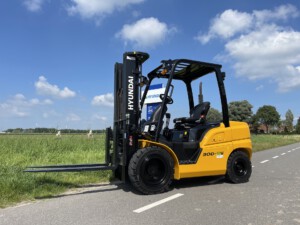
Using a forklift wet floor or outdoor areaWhat should you pay attention to?
A forklift that works perfectly indoors on a dry, flat floor often behaves differently outdoors or on a wet floor. Grip, braking distance, stability, and visibility change as soon as the surface becomes slipperier, uneven, or less predictable. That is precisely why it is wise not to underestimate the use of a forklift outdoors or on wet floors.
In practice, problems often arise not from one major error, but from an accumulation of smaller factors: a slippery turn, a heavy load, a bump, a slope, reduced visibility, or tires that are not well-suited to the environment. With the right choice of machine and a few fixed points of attention, you can prevent many risks.

Why wet floors and outdoor areas require extra attention
On wet or slippery surfaces, a forklift has less grip and a greater chance of slipping or a longer braking distance. When operating outdoors, additional factors often come into play, such as potholes, cobblestones, inclines, gratings, mud, rain, wind, changing loads, and less predictable routes.
This does not mean that a forklift cannot be used safely outdoors or on wet floors, but rather that the machine, tires, driving style, and route must be suitable for those conditions.
The subsoil often determines more than the tonnage.
Many companies first look at lifting capacity, but for outdoor work or wet floors, the demand for subsoil at least as important. A flat warehouse floor requires something different from a forklift than an outdoor area with seams, slopes, thresholds, or wet patches.
This is precisely why your own decision-making tool logically begins with Environment & Substrate. That is exactly the right order if working safely is important.
Slipping on smooth floors is not a detail, but a basic necessity.
What helps in practice
- Drive slower on wet or slippery patches;
- Drive and brake smoothly without abrupt movements;
- maintain a safe distance from curves, dock edges, and racks;
- to be extra alert at intersections and blind spots;
- to keep the last layer stable during movement.
Why this is so important
On a slippery floor, you lose traction and control more quickly. This makes cornering, braking, and correcting more critical than on a dry, flat floor. Driving more calmly gives the operator more control over the machine and the load.
Hills and descents require a different driving style
As soon as a forklift drives on an incline or ramp, the stability of the machine and load changes. Extra caution is required, especially with a load. Therefore, inclines should always be taken into account when assessing the route, choosing the machine, and driving behavior.
In practice, it's smart to determine in advance whether the route contains steep inclines, how steep they are, and whether there is sufficient grip and visibility. Especially in rain or with debris, a slope that is normally easy can suddenly become much more critical.
Which forklift is best suited for indoor, outdoor, or mixed use?
The choice depends on the combination of route, surface and commitment. The following internal links will help visitors further:


Tires, visibility, and the route are at least as important.
Outdoors or on wet floors, you not only want appropriate traction, but also a good tire choice and a logically planned route. Poor grip, wet corners, mud, or uneven terrain make the operation immediately more susceptible to errors or damage.
Visibility also plays a role. Rain, pollution, less light, or splashed dirt can limit the driver's visibility. This makes clear routes, sufficient space, and predictable driving behavior even more important.
What can you check in advance?
- is the substrate flat, wet, slippery, or contaminated?;
- are there inclines, ramps, thresholds, or grates;
- Does the forklift actually fit for indoor, outdoor, or mixed use?;
- are the tires and route suitable for the conditions;
- is there sufficient visibility of curves, dock edges, and intersections;
- Can the load be moved down and stably?;
- Are there pedestrians or other vehicles on the same route?.
Internal links that make this blog extra strong
A short checklist for wet floors and outdoor work
- slow down on slippery or wet patches;
- Keep the load low and stable while riding.;
- extra support on inclines, turns, and docks;
- Check if tire and machine match the surface.;
- Assess visibility, route, and clearance in advance.;
- Avoid sudden braking or steering movements.;
- Choose the right machine based on whether it will be used outdoors or indoors.
For temporary deployment, good advice is extra valuable
During peak periods, project sites, or varied routes, it's wise to consider not only availability but also on-site conditions. A forklift that needs to operate outdoors or on wet floors often calls for a different choice than a machine for a dry warehouse floor.
External sources
Are you unsure which forklift is suitable for wet floors or outdoor terrain?
Provide your ground conditions, route, inclines, load type, and application. We will then advise which Hyundai forklift is best suited for safe and efficient work at your location.
Frequently Asked Questions
Can you use a forklift on a wet floor?
Yes, but you must also take into account grip, braking distance, curves, visibility, and controlled driving behavior.
Which forklift is suitable for outdoor terrain?
That depends on the route and terrain. For heavier outdoor work or rougher conditions, a diesel forklift often makes sense, while mixed use can also work well with LPG.
Why are slopes and ramps so important?
Because they directly affect the stability of the machine and load, especially in combination with rain, slippery conditions, or a heavily loaded truck.
Should you drive slower on slippery floors?
Yes. On slippery or wet floors, a lower speed is a basic measure to maintain control and safety.