When do you have a electric pallet jack, stacker, or forklift Need?
Anyone who needs internal transport equipment will quickly come across three commonly used solutions: the electric pallet truck, the electric stacker, and the forklift. However, these machines are not interchangeable. They differ in application, lifting height, maneuverability, load capacity, and the space in which they perform best.
The right choice therefore doesn't start with the model, but with the task. Do you mainly want to move pallets over short distances? Do you also need to stack? Or do you need an all-round machine for loading, unloading, internal transport, and broader deployment on site?

The difference starts with the function of the machine.
An electric pallet truck is mainly intended for moving pallets horizontally. This makes it interesting for loading and unloading on the floor, short internal trips, dispatch, and logistical movements without needing to stack high.
An electric stacker adds an extra function: you can not only move but also stack at limited heights. This makes a stacker interesting for warehouses, smaller storage areas, and workplaces where pallets need to be placed on racks or in fixed positions.
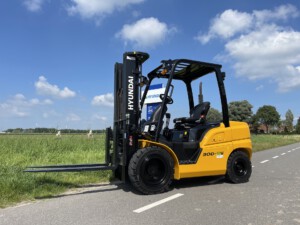
A forklift is the most versatile of the three solutions. It is chosen when the application is broader: loading and unloading trucks, pallet transport, working at greater heights, heavier loads, and use in open spaces or outdoor areas.
When do you choose an electric pallet truck?
Often suitable for
- short distances in warehouse or dispatch;
- moving pallets without stacking them high;
- level floor loading and unloading;
- fast internal logistic movements;
- Compact work on flat floors.
Practical advantage
An electric pallet truck is compact, easy to deploy, and often efficient when the focus is primarily on floor transport. Your homepage also explicitly lists electric pump trucks in the price overview, making this a logical search and blog combination.
When do you choose an electric stacker?
Often suitable for
- warehouse work with light to medium weight pallets;
- Placing pallets on racks or shelves at a limited height;
- smaller storage spaces;
- for indoor use on flat floors;
- Situations where a forklift is too large.
Practical advantage
A stacker is interesting when you need more than a pallet jack, but don't yet need a full forklift. It fills the gap exactly between moving and limited stacking.
When do you choose a forklift?
Often suitable for
- Loading and unloading trucks;
- heavier pallets or higher load;
- more lifting height and wider deployment;
- open spaces, expedition, and production sites;
- mixed indoor and outdoor use or outdoor area.
Practical advantage
A forklift is the most versatile solution. This often makes it the right choice when the task is not limited to just floor transport or just light warehouse stacking.
The right choice depends mainly on three questions
- Do you need to move only or stack as well?
- Do you primarily work indoors on flat flooring, or outdoors as well?
- How heavy and how versatile is the daily commitment?
Someone who mainly moves pallets on the floor is often well-served by an electric pallet jack. Someone who also needs to stack at limited heights will more likely opt for a stacker. And someone who needs a machine for all-around internal transport, loading and unloading, and broader deployment usually needs a forklift.


Which forklift do you choose when a pallet jack or stacker is not enough?
If your situation indicates that you need more than compact warehouse equipment, then you will usually end up with a forklift. The following internal links will then directly help visitors find the right category:
Internal links that make this blog extra strong
Why many companies choose to be too big or too small
In practice, a forklift is often the automatic choice, even though an electric pallet truck or stacker would actually be sufficient for the task. The reverse also happens: companies try to work with compact equipment for too long, while the operation now demands more lifting height, more capacity, or all-round usability.
That's precisely why it's smart to look at the task first and only then at the model. This prevents you from paying for capacity you don't use, or getting stuck with a machine that's too limited.
For temporary deployment, renting is often the smartest move.
Are you still unsure which machine is best suited, or do you temporarily need extra capacity? Then renting is often the most practical first step. You maintain flexibility, can scale up faster, and avoid investing too early in the wrong type of equipment.
External sources
Are you unsure whether to choose a pallet jack, stacker, or forklift?
Please let us know what you want to move, if you need to stack, what the ground surface is, and whether you're working indoors or outdoors. We will then advise you on which machine best suits your situation.
Frequently Asked Questions
When do you choose an electric pallet truck?
Especially when you primarily move pallets horizontally, with little to no stacking.
When do you choose an electric stacker?
When you not only want to move but also place pallets at a limited height.
A forklift is better than a stacker when you need to: * **Lift heavier loads:** Forklifts generally have higher weight capacities than stackers. * **Transport loads over longer distances:** Forklifts are designed for more frequent and longer travel. * **Reach higher shelving:** Many forklifts can achieve greater lift heights than stackers. * **Work in confined spaces or narrow aisles:** Some types of forklifts, like reach trucks, are specifically designed for this. * **Handle a wider variety of pallet types or loads:** Forklifts offer more versatility in load handling. * **Operate on uneven or outdoor surfaces:** Some forklifts are better equipped for varied terrain. * **Require higher speed and maneuverability for frequent tasks:** Forklifts are typically faster and more agile.
When you need more capacity, more lifting height, wider deployment, or even outdoor use, a forklift is often the better choice.
Can I rent first and buy later?
Yes, for companies that want to grow into a fixed machine later, it makes sense to rent first and then consider buying or leasing.