
Technical Guide Forwarding equipment Rest capacity Hyundai forklift rental

Calculating the rest capacity of a forklift with attachments

A 2.5 or 3-ton forklift often seems more than sufficient on paper, but as soon as you work with attachments such as a fork positioner, side shifter, rotator, or special clamp, the real picture changes. The extra weight of the attachment and the load center of gravity that is further forward can cause the practical residual capacity to be lower than the nominal capacity on the nameplate.

Therefore, when choosing a forklift for warehousing, logistics, production, construction, or project work, you don't just look at tonnage, but also at the load center, mast, lifting height, tire choice, and the influence of attachments on the overall configuration.

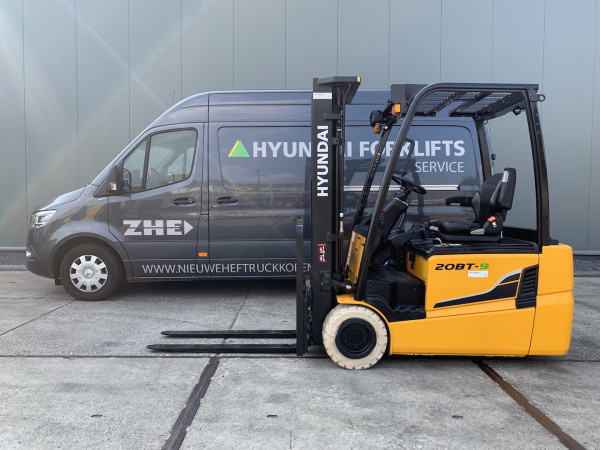
Hyundai forklift from Heftruckhuren.com in rental use where correct configuration and residual capacity are important

It's not just lifting capacity that counts. With attachments, it's all about the total configuration: truck, mast, attachment, load center of gravity, and operating environment.

Nominal isn't always practical

The specified capacity of a forklift applies to a specific configuration, a certain center of gravity, and a specific lifting height.

2. Attachments change the forklift

An attachment adds weight and often shifts the load further forward, which directly affects the rest capacity.

The right choice prevents standstill.

By calculating thoroughly beforehand, you can prevent a truck that looks good on paper but has too little margin or stability in practice.

Restcapaciteit is het maximale gewicht dat een heftruck kan tillen op een bepaalde mastlengte of met een bepaald lastzwaartepunt.

Rest capacity is the capacity that remains in practice with the actual deployment of the forklift truck. Therefore, it is not simply the figure from the brochure or the standard capacity of the truck. As soon as you use a different mast, a higher lifting height, or attachments, you must look at the configuration as it is actually deployed on your floor or site.

Which factors influence the residual capacity?

  • The dead weight of the front-end equipment
  • The extra overhang of the attachment
  • A higher working center of gravity
  • Headroom and mast configuration
  • Type last: compact, lang, unstable or asymmetrical
  • Indoor or outdoor use, surface and driving conditions

What attachments are common?

  • Fork positioner for variable pallet sizes
  • Sideshift for more precise positioning
  • Tipping and emptying rotator
  • Paper roll clamp for specific goods
  • Extension forks or special forks for unusual loads
  • Bucket or other project-oriented attachment equipment

This is how a specialist looks at residual capacity

In practice, good selection doesn't start with the question “how many tons should the truck be able to lift?”, but with the question “what load, with what attachment, at what height, in what environment, and with what safety margin?”.

1
To determine the last

What is the actual weight, dimension, and distribution of the heaviest load?

2
Take attachment with you

What is the weight of the front equipment and how much additional front overhang is added?

3
Check height & mast

At what lifting height should the truck remain safe to operate?

4
Build in margin

Ensure an adequate safety margin instead of calculating exactly at the theoretical maximum.

Simple calculation example: indication of remaining capacity

The example below is intended as a quick initial indication. In practice, you should always refer to the correct capacity plate, load chart, and the configuration of the specific truck.

Situation Value Explanation
Rated capacity 2.500 kg With the standard configuration and, for example, a 500 mm load center of gravity
Actual center of gravity 600 millimeters Due to a longer or differently constructed load, or due to attached equipment
Indicative recalculation 2.083 kg 2,500 x 500 / 600 = approximately 2.083 kg
Special point of attention Weight attachment The dead weight and the construction of the attachment can further reduce the practical margin.

This is an indicative example. Use it only as an initial check and not as a substitute for the official capacity chart or truck configuration assessment.

Why a fork positioner or side shifter is not “free”

Attachments often offer significant practical benefits. You work faster, more accurately, and in some situations more safely. However, this also means the truck operates in a different technical configuration than standard.
What you gain with preparatory equipment

  • Work faster with varying pallet and load sizes
  • Fewer correction runs during loading, unloading, and stacking
  • Greater precision in warehouse work and production environments
  • Better handling of specific goods or project cargo

What you technically need to consider

  • Extra weight on the front of the truck
  • Greater distance between the fork carriage and the load's center of gravity
  • Possible impact on visibility, overhead clearance, and maneuvering space
  • Need for a heavier truck or different mast configuration
Electric Hyundai forklift from Heftruckhuren.com upon delivery for warehouse or logistics use
For warehousing and logistics, not only capacity is important, but also precision, visibility, and the right attachment choice.
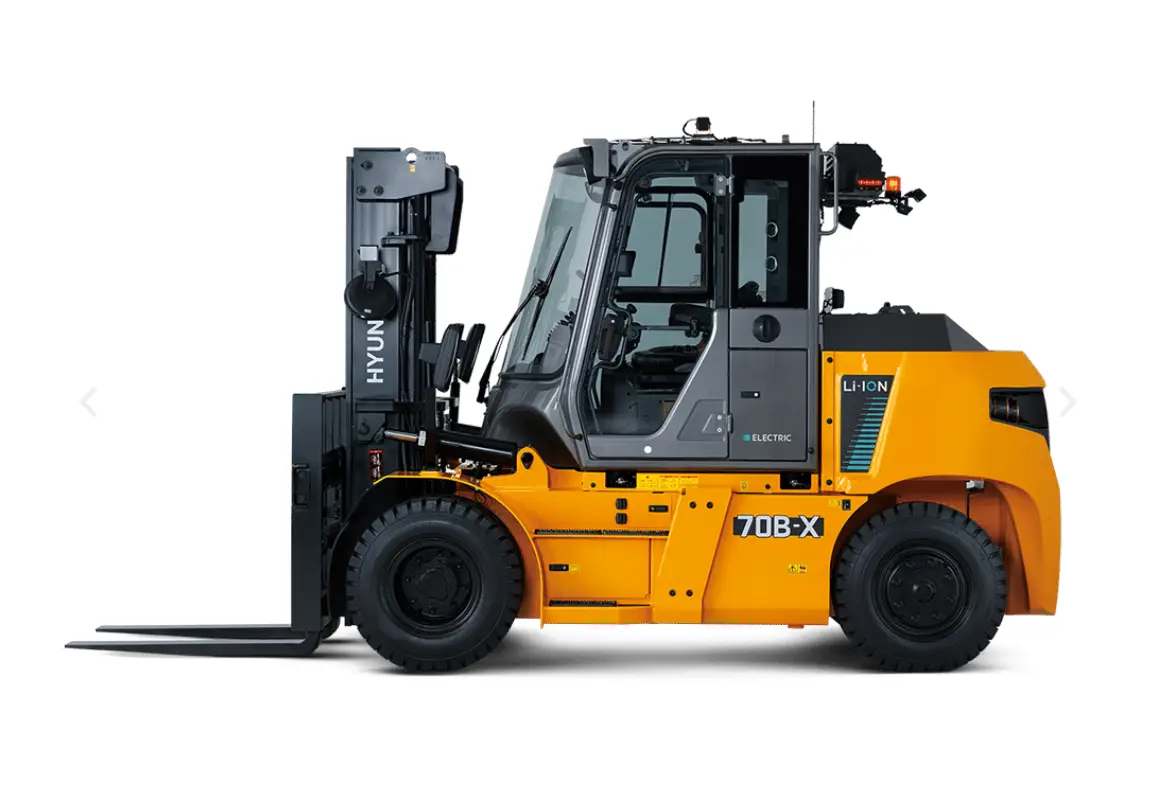
Hyundai 70B-X Electric Forklift as an Example of Powerful Configuration for Higher Residual Capacity and Heavy Duty
For heavier or more complex deployments, a larger truck with more leeway can be a smarter choice than meticulously calculating based on exact specifications.

When is it better to choose a heavier forklift right away?

Scaling up is smart when:

  • Structural use of heavy or long loads
  • A strong focus on greater lifting height
  • Combination of attachment and intensive daily commitment
  • Outdoor work, slopes, or rough terrain
  • Project work that leaves little room for error or downtime

Practical questions beforehand

  • What is the heaviest actual load, not just the average load?
  • Is the load picked up compactly or rather long/voluminous?
  • How often is work performed at maximum height?
  • Is it for indoor, outdoor, or mixed use?
  • Which attachment is really needed and which isn't?

Common mistakes with remaining capacity

Error Consequence Better approach
Only looking at the truck's tonnage Too little margin in practice Always take the load center, height, and attachment into account
See attachment as a “side issue” Incorrect configuration or underestimation of the load Always assess weight and build beforehand
Do not take the heaviest peak load into account Problems with some critical actions Choose the most severe realistic scenario
Don't build in a safety margin Less stability and less flexibility Work with a comfortable margin rather than right at the limit

External sources and technical context

If you want to delve deeper into this technically, the sources below will be useful. Use them as background information, but always align the final assessment with the specific truck and configuration you will be deploying.

Frequently Asked Questions about Residual Capacity and Auxiliary Equipment

What is the difference between nominal capacity and residual capacity?
Nominal capacity is the standard stated capacity of the forklift under a specific configuration. Residual capacity is what remains in practice with your actual deployment, including mast, lift height, attachment, and load center of gravity.
Does a sideshift also affect the residual capacity?
Yes. A sideshift or fork positioner also adds weight and changes the configuration at the front of the truck. The extent of this influence depends on the type of attachment, attachment size, and load.
Can I easily calculate remaining capacity myself?
You can make an initial indication, but for the final assessment, you must rely on the correct capacity plate, load diagram, and the specific configuration of the truck and attachment.
When is it wiser to choose a heavier forklift?
Especially with structural use of attachments, higher lift heights, longer or heavier loads, or when working outdoors with little room for error or downtime.
What information do I need to provide for appropriate advice?
Please provide: weight and dimensions of the heaviest load, desired lifting height, type of attachment, indoor or outdoor, ground conditions, operating hours, and any restrictions such as narrow aisles or low passages.

Are you unsure about the right truck with auxiliary equipment?

We are happy to help you think about lifting capacity, residual capacity, attachment choice, mast configuration, and deployment environment. This way, you prevent a forklift from seeming suitable on paper but having too little margin in practice.
Easily request a quote for your forklift

Would you like to rent a forklift and know the costs immediately? Then request a quote without obligation using the form below, and we will contact you within 24 hours.