CSRD and internal transport: what do clients ask of suppliers?
Large companies must increasingly justify how they handle sustainability, supply chain risks, and indirect emissions. As a result, suppliers are also more frequently asked about internal transport, forklift types, hours of operation, energy consumption, service, and the reasoning behind certain choices. This is precisely where a professional rental solution becomes increasingly relevant.

Contents
- What exactly is CSRD?
- Why clients ask more questions
- What information do they often want to know
- Why internal transport plays a role in this
- How forklift rental helps with justification and flexibility
- Electric, LPG, or diesel: what is justifiable?
- Practical checklist for suppliers
- Frequently Asked Questions
What exactly is CSRD?
From Corporate Sustainability Reporting Directive (CSRD) is European legislation that further structures sustainability reporting for certain companies. In practice, this means that larger companies must better explain how they deal with topics such as climate, energy, supply chain risks, and the material impacts of their business operations.
At the same time, it is important to state the current context clearly: in 2025, the European Commission published the Omnibus package with proposals to simplify reporting obligations and limit the scope. This does not change the fact that sustainability and supply chain data remain important themes. On the contrary: many companies continue to request information from suppliers, even when that supplier itself does not formally fall under the heaviest reporting obligation.
Why clients in logistics and industry are asking more questions
Large clients must be able to better substantiate their own sustainability story. This means they look not only at their own building or fleet but also at suppliers, purchasing choices, and operational partners. Especially in logistics and industry, internal transport is relevant in this regard, as forklifts have a direct impact on energy consumption, deployability, safety, and the choice between electric, LPG, or diesel.
More focus on chain data
Clients increasingly want to know how processes run, what type of equipment is being used, and why that choice is logical for the work environment.
More attention to indirect emissions
Scope 3 concerns indirect emissions in the value chain. As a result, suppliers are increasingly asked about choices that previously seemed purely operational.
More demand for substantiation
Not only “we work sustainably,” but also: why exactly this truck, this drivetrain, this deployment duration, and this service model?
More importance of flexibility
Companies want to be able to scale up, become more sustainable, or test more quickly without making large upfront investments.
What information do clients often want to know
In practice, the questions rarely focus solely on “CO₂ per truck.” More often, customers want to understand how your operations are structured and whether your choices are logical, efficient, and future-proof. These are common topics:
| Subject | Client's sample question | Why this is relevant |
|---|---|---|
| Forklift | Do you run on electricity, LPG, or diesel? | Provides insight into emission profile, work environment, and practical deployment. |
| Use case | Is the truck for indoor, outdoor, or mixed use? | Helps to assess whether the chosen solution is logical. |
| Operational justification | Why is this truck suitable for your workflow? | Show that the choice was made consciously based on effort, burden, and hours. |
| Service and maintenance | How do you keep the machines safe and operational? | Underpins business security, safety, and professional management. |
| Temporary capacity | How do you handle peak load or project work? | Show how you handle assets and capacity intelligently and flexibly. |
| Data and transparency | Can you explain how your choice fits with more sustainable internal transport? | Important for supplier reviews and supply chain discussions. |
This makes one thing clear: internal transport is no longer just a practical facility choice. It is increasingly also a topic within procurement, compliance, ESG, and supplier management.
Why internal transport plays a bigger role in this than many companies think
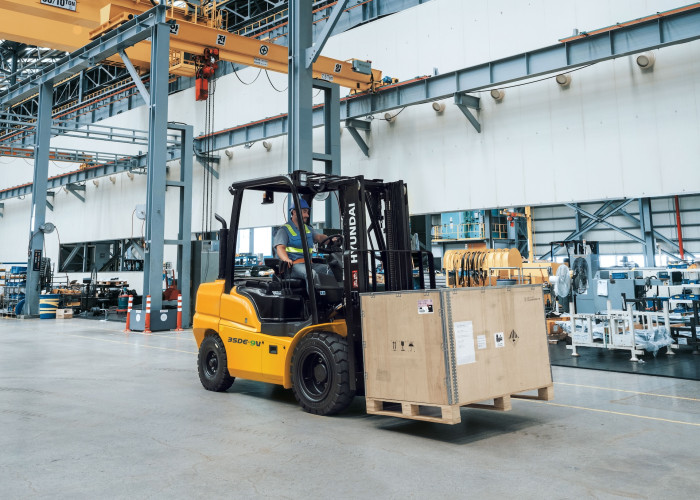
Forklifts are visible on the work floor, are an integral part of daily logistics processes, and directly impact energy, lead time, safety, and service. Therefore, they are a logical talking point whenever a client wants to know more about how you work. Especially in warehouses, distribution, production, and industry, the choice of internal transport is more than just a technical purchasing decision.
Efficiency
The right truck prevents detours, downtime, overcapacity, and inefficient use of equipment.
Safety
Service, inspection, and a suitable model are important for a reliable and safe workplace.
Justification
A well-chosen forklift is easier to explain to a customer, auditor, or internal ESG manager.
How forklift rental helps with justification, flexibility, and modernization
For many companies, renting is actually attractive because you can switch more quickly without being tied down to a large investment or a wrong long-term choice. This is useful during peak periods, project deployment, test phases, or a gradual transition to electric equipment.
What practically solves
- Faster access to modern equipment
- Flexible scaling up and down per location or project
- Less chance of idle company equipment
- Earlier tests with electric insertion or Li-ion
- Include service and support in the concept.
What helps substantiate that for the customer
- You choose equipment based on real need
- You prevent unnecessary overcapacity
- You can better match the work environment with the right drive.
- You're showing that maintenance, inspection, and uptime are seriously managed.
- You work systematically rather than ad hoc.
Check out our page on Full-service forklift rental when employability, maintenance, and support play an important role during the rental period.
Electric, LPG, or diesel: which is defensible to clients?
One mistake many companies make is thinking that only electric is “good” and everything outside of it is immediately “wrong.” In reality, it's about whether a choice fitting and well-founded The best choice depends on your workplace, operating hours, infrastructure, substrate, peak load, and load weight.
Electric forklift
Often logical for warehousing, distribution, and production. Quiet, emission-free on-site, and pleasant for daily indoor use.
LPG forklift
Interesting for mixed indoor and outdoor deployment, where flexibility and quick turnaround are important.
Diesel forklift
Strong for heavy outdoor applications, industry, docks, and situations where high power and robustness are needed.
The best explanation for the customer
Not “we've always done it this way,” but: this type of truck is suitable for this location, these loads, these hours, and this way of working.
Do you want to better justify which forklift fits your operation?
Provide your working hours, location, lifting capacity, and work environment. Then we will advise which Hyundai forklift best suits your logistics process and for questions from clients.
Greater transparency often starts with simple, practical answers.
You don't need to write a full sustainability report right away to effectively communicate with customers. Often, it starts with a few clear answers:
- What type of forklift do you use and why?
- Why is that solution logical for your workplace?
- How do you arrange maintenance, service, and safety?
- How do you handle peak loads or temporary additional capacity?
- What are you consciously choosing to go electric for, and what not yet?
Whoever organizes that story well is stronger in conversations with clients, auditors, and purchasers. Not because you have to have everything perfect, but because you show that choices were made consciously, explainably, and professionally.
Practical checklist for suppliers in logistics and industry
Do you want to be better prepared for customer questions? Then use this short checklist:
Map your internal transport
Which trucks do you use, at which locations, and for which tasks?
2. Note why that choice is logical
Think about indoor/outdoor use, lifting height, operating hours, load weight, and loading capabilities.
3. Visible service and safety rules
Inspection, maintenance, transfer, and support must be handled professionally.
4. See where you can be flexible
Rentals are often a logical step for project work, peak loads, or a test with electrical deployment.
This article is about the questions clients ask their suppliers about internal transport. Would you like to know how renting a forklift fits in with your own emissions targets? Then read how forklift rental contributes to your Scope 3 emissions targets.
The Role of HeftruckHuren.com in a Strong Supplier Story
At HeftruckHuren.com you can choose from 300+ machines in stock with nationwide delivery, 10+ service and rental locations and support during the rental period. You will not only quickly receive a machine, but also advice on what suits your environment, hours of use, and purpose.
Electric
1.5 to 18 tonnes for warehouse, logistics, and emission-sensitive locations.
LPG
1.5 to 5 tonnes for flexible indoor and outdoor use.
Diesel
2.5 to 30 tonnes for heavy-duty applications, outdoor terrain, and industrial use.
Frequently Asked Questions about CSRD and Internal Transport
Will every company have to report fully on the CSRD themselves in 2026?
No, that depends on the size of the company, the legal structure, and the ultimate application of the rules. However, many smaller or medium-sized suppliers in practice receive requests from larger customers who need data from their supply chain.
Why do customers ask about forklifts or internal transport?
Because internal transport is part of a company's operational reality. It affects energy, emissions, availability, safety, and the way an organization structures its processes.
Is renting better than buying from an ESG perspective?
This depends on your situation. Renting is often strong when you need flexibility, want to implement modern equipment, work on a project basis, or want to become more sustainable step by step without making large investments upfront.
What information can I have ready as a supplier?
Think about the type of truck, deployment location, reason for selection, service and maintenance, operating hours, and whether you can flexibly organize peak capacity.
Can I test what works best with forklift rental first?
Yes. That is precisely a strong advantage of renting. You can test in practice what works for your location, processes, and sustainability goals before you scale up or invest structurally.
Would you like to be able to better explain to customers why your internal transport is smartly organized?
We help you find a suitable Hyundai forklift for warehouse, logistics, industrial, or project use. We don't just look at availability, but also at what makes sense for your workspace and your story to clients.
Forklift overview
Need a forklift yourself?
Request a no-obligation quote — you will receive a competitive rental price tailored to your needs.