CornerstoneHigh Voltage • 4–9 tonAward/recognition
Hyundai B-X High Voltage: Award-Winning Electric Forklift (What is High Voltage and Why is it Interesting?)
“High-voltage” isn’t just marketing. For Hyundai’s B-X series, it means a 309–348V system that
diesel-like performance delivered, but then emission-free, met snelladen and built for heavy, wet, and cold conditions.
In this article, I'll explain what it means technically and what you gain from it in practice.
Practical starting point: we deliver our forklifts Always VA-approved A voice-over by execution + charging strategy depending on deployment (hours, center of gravity, ground, indoor/outdoor).
The term “high-voltage” for electric forklifts refers to the operating voltage of the electrical system.
Hyundai positions the B-X series as “next generation” with a 309–348V high-voltage system (depending on model/series).
Higher voltage means that for the same power less power need.
Power without compromise
Less current (A) at equal power (kW) → less losses and less heat in cables/connectors/controller.
More stable performance
With the right charging strategy and battery management, the truck continues to “power through” under heavy use, comparable to the feeling of a diesel engine.
The B-X heavy-duty line is designed as an alternative to diesel, but electric.
2) Why is high voltage interesting (especially at 6-9 tons)?
In the “heavy” class, it's all about perseverance, endurance en reliability.High-voltage helps precisely at those points. Specifically, you see benefits such as:
More peak power for heavy-duty jobs
During intense rides, inclines, rough terrain, and heavy loads, you often need a lot of power for short bursts.
Faster loading, less downtime
B-X is designed for (fast) charging and opportunity charging — allowing you to intelligently schedule charging moments instead of accepting downtime.
Lower heat = longer lifespan
Less heat in electrical components helps reliability and lifespan, especially with continuous use.
All-weather commitment
Hyundai specifies heavily sealed components (IP ratings) and deployment in rain/cold — relevant for outdoor work, ports, building materials, wood, steel.
Practical advice: high-voltage is especially interesting when you normally use diesel “because electric can't handle it.”
In the 4–9 ton range, you now see that electric can indeed compete seriously—provided you choose the right configuration (tires, mast, fork length, cabin) and charging method.
For whom is this a logical step?
High-voltage heavy-duty electric becomes interesting as soon as you recognize one or more of these situations:
Multi-shift deployment (2-3 shifts) of high operating hours per day.
Strict emission or noise regulations (interior, environmental zones, environmental pressure).
Quick good advice? Send your heaviest load + load center of gravity, lifting height, hours of use, and location.
Then you will immediately receive the correct configuration and a workable loading plan.
5) Award-winner: what does that say (and what doesn't)?
“Award” is only valuable if you know Why Something wins.
The B-X high-voltage series is marketed as a product with diesel performance without emissions and with a focus on uptime (fast charging, heavy-duty use).
Think of it as signal of relevance — and always combine that with your own betting profile.
What it does say
The sector views this as a significant step towards “replacing diesel” in heavy-duty segments.
What it doesn't say
That it is automatically perfect for your location without the right battery/charger/version.
Authority links (useful for future internal linking):
• Hyundai's own “High Voltage” B-X page (product/technology)
• Brochure 60/70/80/90B-X (specifications)
Readers’ Choice / Product of the Year reporting (award/news)
6) Directly to the 7/8/9-ton models (internal links)
These are strong internal “money pages” to link to from this cornerstone article. Useful for SEO and for visitors who want to compare directly.
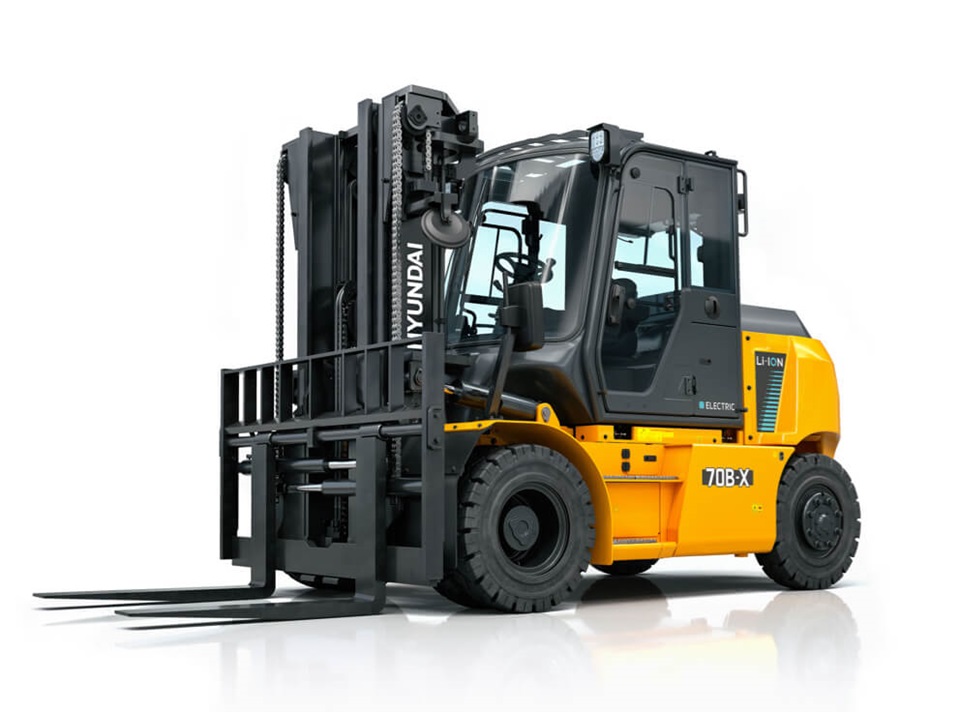
7 ton • 70B-X
Electric forklift 7 ton (Hyundai B-X)
Heavy-duty, emission-free, and suitable for intensive use with fast charging/continuous operation.
High-voltage with a forklift refers to electric forklifts that use a high-voltage battery system, typically in the range of 48 volts or higher, for their power source. This is in contrast to lower-voltage systems that might be found in smaller electric equipment. High-voltage systems generally offer more power, longer run times, and faster charging capabilities compared to their lower-voltage counterparts.
It's about the system voltage (V). At higher voltages, the same power can be delivered with less current, which improves efficiency and thermal behavior (heat).
Is high-voltage only interesting for 7-9 tons?
The advantage is clearest with heavy, intensive use. But even in 4–5.5 tons, it can be interesting if you put in many hours and want to load quickly.
Can high-voltage electric really replace diesel?
In many applications, yes, provided you choose the right configuration and charging strategy. This is especially true in heavy-duty segments where emission-free operation and uptime are important.
Where do heavy electric forklifts usually go wrong?
Due to insufficient network capacity/charger, wrong tires, or insufficient attention to the center of gravity and driving distances. Therefore, prior intake is crucial.
What information do I need to provide for a suitable proposal?
Heaviest load + load center of gravity, lifting height, fork length, hours of use per day, indoor/outdoor, surface, and location (for loading/transport).
Are your machines inspected as standard?
Yes. We deliver our forklifts as standard VA-approved, so you can start ready for the work floor.
Do you want to know if the B-X High Voltage fits your bid?
Start via forklift rental or view directly
electric forklift rental.Bell: 0168 467 467 of mail sales@zhe.nl.
,
Easily request a quote for your forklift
Would you like to rent a forklift and know the costs immediately? Then request a quote without obligation using the form below, and we will contact you within 24 hours.